Best Plywood Thickness for Cornhole Boards Explained
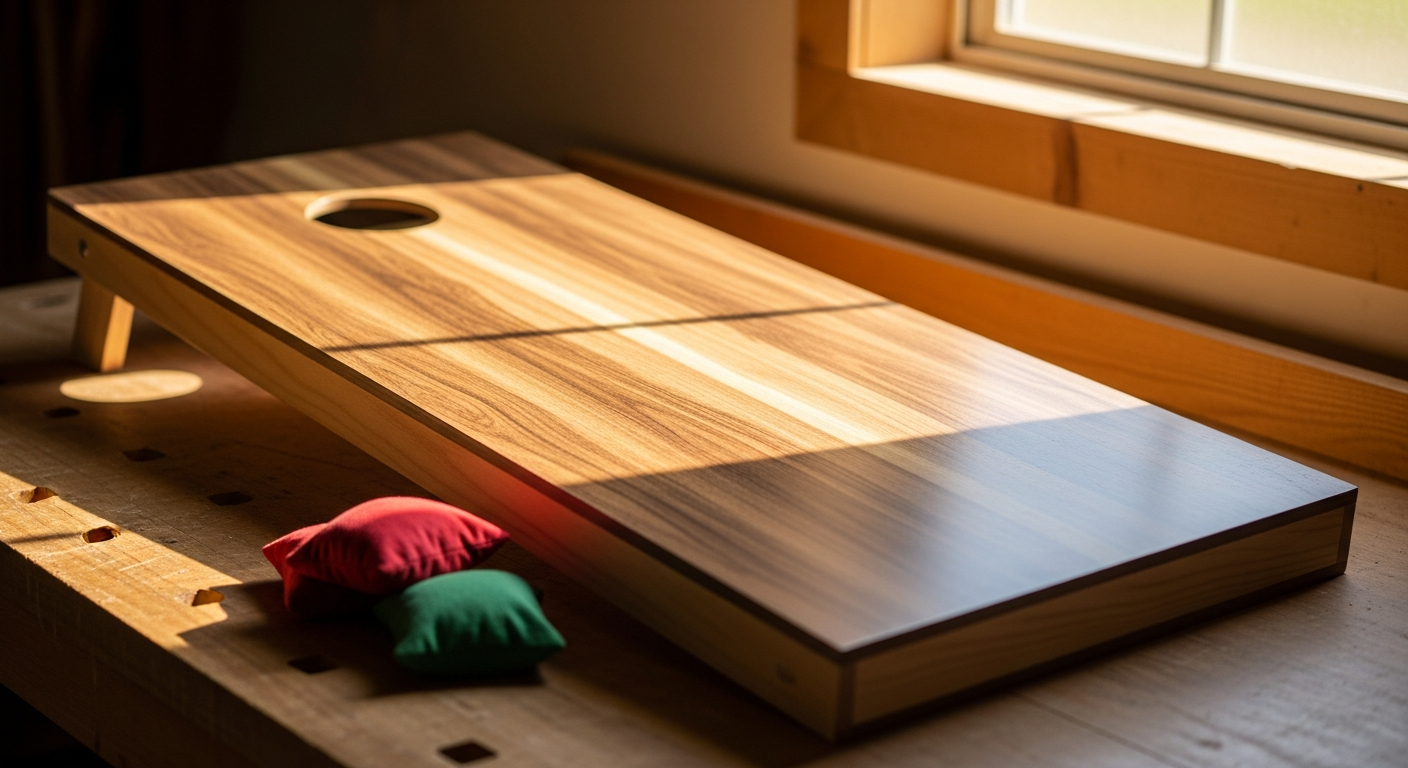
If you have ever tossed a bag onto a wobbly backyard board and watched it spring straight back off, you already understand why the best plywood thickness for cornhole boards matters so much. The short answer is 3/4 inch (18mm) Baltic Birch, ideally with internal bracing. But the why behind that number is where the real game lives. The thickness of your deck quietly controls how a 16-ounce bag behaves the instant it lands, and that single property separates a frustrating set from one that plays clean every single throw.
Let's break down the kinetic story of a bag hitting a board, then look at how that translates into real decks you can actually shop for.
The Best Plywood Thickness for Cornhole Boards Starts With Bounce
When a bag lands, your board behaves like a spring. Physics describes a spring with something called a spring constant, often written as k. A high spring constant means the surface is stiff and barely deflects under load. A low spring constant means the surface flexes a lot. Plywood thickness is the biggest lever on that spring constant, because stiffness scales dramatically with depth, not linearly.
Here is the part most people miss: a deck's resistance to bending grows with the cube of its thickness. Doubling the thickness of a panel makes it roughly eight times stiffer, all else equal. That is why the jump from a thin hobby panel to a true 3/4 inch deck is not a small upgrade. It is a different category of surface entirely.
Thicker, stiffer plywood does two helpful things at once:
- It deflects very little when the bag hits, so almost no energy gets stored and returned to the bag.
- It spreads the impact load across a braced frame instead of flexing in the middle like a drum head.
Thin, unreinforced decks do the opposite. They behave like a trampoline. The panel bows down, stores the bag's kinetic energy as elastic energy, then snaps back and hurls some of that energy into the bag, sending it skipping or popping off the surface.
Restitution: The Number That Decides If Your Bag Stays Put
Engineers measure bounciness with the coefficient of restitution, a value between 0 and 1. A value near 1 means a collision returns almost all of its energy (think a superball). A value near 0 means the energy is absorbed and the object basically stays put (think a beanbag on carpet).
A quality cornhole setup wants low restitution at the bag-to-board collision. You want the bag to thud, grip, and slide rather than rebound. Two things drive that low number:
- The bag itself. A 16-ounce bag is mostly loose fill (resin pellets or corn) that deforms on impact and converts motion into internal friction and heat. That is energy that never comes back.
- The deck stiffness. A high spring-constant panel barely moves, so it does not add a return spring to the equation.
Put a soft, dead 16-ounce bag onto a stiff, braced 3/4 inch Baltic Birch deck and the collision is heavily damped. The bag lands, the surface barely registers it, and the bag stays in scoring position. Put that same bag onto a thin flexing panel and you reintroduce the trampoline effect, raising effective restitution and turning makeable shots into roll-offs.
Why 3/4" (18mm) Baltic Birch Is the Sweet Spot
Regulation boards are 2 feet by 4 feet (24 by 48 inches). That is a big span for a top to hold flat under repeated impacts, which is exactly why thickness and material quality matter together.
Baltic Birch earns its reputation here because it uses thin, void-free veneer plies with strong glue lines. More plies in the same thickness means a more uniform, predictable stiffness across the whole sheet, with fewer soft spots that cause a bag to behave differently in one corner versus another. At 3/4 inch (18mm), a Baltic Birch deck hits the practical limit where:
- The spring constant is high enough that a dropped bag barely bounces.
- The panel resists warping and humidity-driven cupping over a 4-foot span.
- The board is still light enough to carry and fold.
Go thinner and you risk trampolining and warping. Go much thicker and you mostly add weight without meaningfully improving play. That balance is why serious builders converge on this spec.
Bracing matters just as much as the raw number. A thick top still needs a frame and internal supports to keep it from flexing in the unsupported middle, where bags tend to land.
How the Top Brands Hit (or Beat) the Thickness Benchmark
When you compare premium decks in our reviews, you will notice the best-known builders cluster right around that 3/4 inch target and then differentiate themselves with bracing and finish. A few examples worth knowing:
- AllCornhole PRO Series uses an 18mm Grade-A Baltic Birch deck with a dual-cross-beam frame, dado and dowel joinery, and an H-leg design. That is thickness plus aggressive bracing, the textbook recipe for a high spring constant and dead-flat play.
- Cornhole Solutions Pro Solution Series runs an 18mm (3/4 inch) Baltic Birch deck with vertical interlocking quad bracing and an airmail blocker, engineered for fast, consistent play.
- Cornhole Ace Professional Series pairs a 3/4 inch Baltic Birch deck with double center-support bracing, attacking the exact middle-of-the-board flex zone where bags land.
- West Georgia Cornhole ACL Elite X-Factor takes a slightly different route with a 3/4 inch (15-ply) marine-grade plywood deck and a patented underside "X" bracing system, proving that thickness plus smart structure beats thickness alone.
- Slick Woody's Premium Regulation Series uses a 5/8 inch Baltic Birch deck with hardwood poplar frames and integrated crossbar leg support, a slightly thinner top that leans on framing and an optional all-weather Trex PVC surface.
The pattern is clear: reputable boards live in the 5/8 to 3/4 inch Baltic Birch range, and the higher-end the play, the more the builder invests in bracing under that thick top. You can browse the makers themselves on our brands page to compare construction philosophies.
Don't Forget the Slide: Finish and Friction
Thickness controls bounce, but the clear-coat controls slide. Once a bag lands and stays put, how far it travels depends on the friction between the bag fabric and the top finish. Quality UV or polyurethane coatings, like the proprietary multi-step top-coats and humidity-resistant clear coats these brands use, give a consistent slide speed even as the weather shifts. A great deck combines a high spring constant (low bounce) with a tuned coefficient of friction (predictable slide). One without the other is only half a board.
Quick Buyer's Checklist for Deck Thickness
When you evaluate any board, run through this:
- Top thickness: Aim for 3/4 inch (18mm) Baltic Birch; 5/8 inch can work with strong framing.
- Plywood type: Baltic Birch or marine-grade plywood beats generic big-box plywood for void-free, uniform stiffness.
- Bracing: Look for cross-beams, quad bracing, or center supports under the deck, especially mid-board.
- Finish: A UV-cured or poly clear coat for a stable, humidity-resistant slide.
Nail those four and the kinetic story takes care of itself: the bag lands, barely bounces, grips, and slides into the scoring zone.
Design Your Own Board While You Shop the Specs
Understanding the best plywood thickness for cornhole boards turns a confusing spec sheet into a simple buying decision, and it helps you see why a premium braced deck plays so much cleaner than a thin bargain panel. When you are ready to buy, compare the construction details in our reviews and find a builder that matches your play style.
Want the fun part first? Mock up your dream top art for free in our board designer. Drag in your own images, add text and gradients, try the worn distressed look, or start from one of 149 premade flag templates, then save your design. Print-and-ship custom wraps are launching soon, so design now and be ready to put your graphics on a deck that actually plays the way the physics says it should.
As an Amazon Associate we earn from qualifying purchases.
Keep exploring
⭐Reviews & guides
Recommended boards, bags, lights, and accessories.
🏷️Brands & companies
Board makers, bag makers, apparel, and accessory brands.
📅Tournaments
Live ACL / ACO event listings + local tournaments.
🥇Meet the pros
Active ACL & ACO pro rosters with hometowns and rankings.
🎨Custom Designer
Drag-and-drop a custom board face in your browser.
🖼Community gallery
Browse, vote, remix, or buy designs from other users.